
Coryell County Court Calendars Explained
Coryell County district calendars come out mainly as dated docket PDFs. The 52nd Judicial District Court posts files tied to specific dates. Labels cover criminal, family, civil, and jury matters. The 440th Judicial District Court splits its settings into separate lists. They cover criminal, civil, civil-family, TDCJ, and other matters. County Court at Law keeps its own links for civil, criminal, guardianship, juvenile, and probate dockets.
Each court layer holds only its own cases. A JP or municipal matter never jumps onto a district calendar just because it arose in the county. Copperas Cove puts out a dated municipal docket. Gatesville posts category and date links. For other city courts, a direct call to the clerk may be the only way in.
Coryell District Docket PDF Layer
The district court pages serve as Coryell County's public calendar index. Filenames help narrow the date, but the PDF heading controls. Open the file and read the court number, category, judge, date, and start time. On the 440th page, an "Updated" link signals a revised file. It may have replaced the first version.
The official 52nd court page shows the dated docket files themselves. That is why the court page, not some unrelated records index, is the practical start for a district setting.
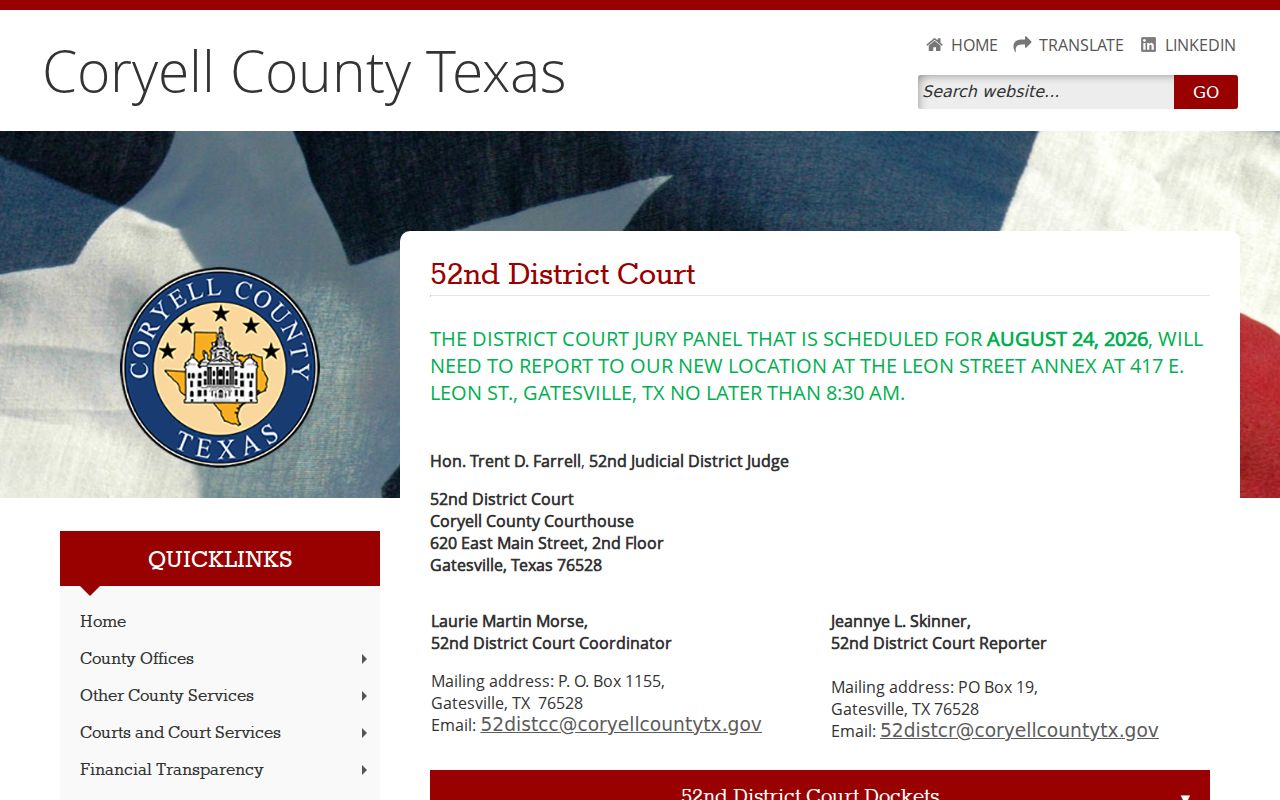
Each dated docket belongs to the court that issued it. For the newest file, always go back to the live official page.
Finding Your Court Date
When a deadline matters, use every Coryell County court-date channel at once. Online dockets are fast, yet the clerk, the coordinator, your case papers, and the courthouse itself remain essential fallbacks.
- Read the notice or pleading and identify the court number and cause number.
- Open the correct district, County Court at Law, JP, or municipal page and select its date-based docket.
- Search the PDF for the cause number. If it is image-based, inspect each page and verify the case style.
- Check re:SearchTX under Hearings or Cases when statewide coverage may provide a second result.
- Call the District Clerk, County Clerk, precinct clerk, or municipal clerk if the listing is absent or unclear.
- Confirm the judge, time, location, and any remote-hearing note with counsel or the court coordinator.
- Recheck the official court page shortly before the appearance for an updated file, closure, or relocation notice.
The District Clerk's main line is (254) 865-5911, open weekdays 8 a.m. to 5 p.m. with lunch from noon to 1. The County Clerk shares that main number and lists hours of 8 a.m. to 4:30 p.m. If a phone call cannot pin down the date, go in person or send something in writing.
Coryell Courtrooms Can Move
A posted date does not settle where you appear. Coryell County closure and jury notices show that operations can shift when a building closes or court activity changes. That makes the county home page part of any current-date check, especially during a closure. A notice on your case papers or a coordinator's direction can outrank an old PDF.
Myth: A saved calendar fixes the courtroom.
Fact: The case can keep its date while the room, building, judge, or appearance method changes.
Never assume the courthouse or annex from an older setting. Before you travel, compare the current docket header with the latest official notice.
How to Read a Court Setting
A Coryell County court setting is a scheduled procedural event, nothing more. District dockets follow a consistent core of identifiers, with extra fields for criminal or civil-family matters.
| Date | The listed hearing or session date, which may differ from the filing date. |
|---|---|
| Time | The docket call or individual event time shown in the row or header. |
| Courtroom | The court or location in the current notice; verify it because operations can move. |
| Judge | The regular or visiting judge assigned to that session. |
| Setting Type | The event, such as arraignment, pretrial, plea, summary judgment, temporary orders, or probate. |
| Cause Number | The case identifier, such as 24-28810 or DC-21-51905. |
A setting is not a ruling. Labels like "pre-trial," "appearance," and "bond hearing" describe what is planned. To learn what happened, check later docket entries or request the resulting order.
Coryell Court Setting Labels
Local wording helps you tell a calendar group from a result. Coryell dockets rely on specific labels, and a few deserve a plain definition.
- Jury docket
- A list tied to jury selection or a jury trial session, not proof that a trial began.
- TDCJ
- A 440th docket category for matters involving Texas Department of Criminal Justice proceedings.
- Videoconference
- A logistics note that a proceeding may use remote technology, subject to court approval.
- Visiting judge
- A judge other than the regular assigned judge presides for the session.
- Reset
- A new date assigned after the prior setting changes.
The Coryell County local label controls over any generic web glossary. Ask the issuing court to define a code that affects an appearance or deadline.
Continuances, Resets, and Cancellations
A reset moves the setting; it does not dismiss the case. An updated PDF may show the new date. But a dropped row can also mean a revised docket, a move to another list, or a court action missing from the older copy. When two sources conflict, contact the coordinator.
Coryell's local rules demand more than a casual scheduling call. A contested setting requires coordinator contact, coordination with opposing counsel, and an agreed setting form. Without agreement, the moving party files a motion for notice of hearing. It must state the coordination attempts and available dates. Continuances without all parties' consent must follow the Texas civil rules. They also require a proposed hearing order.
Remote treatment is court-controlled too. For a nonevidence matter, the local route is a filed motion. Add coordinator confirmation that the request was granted.
Verify a Coryell Hearing
If the PDF and a case notice disagree, keep both. Confirm through the court. Start with the coordinator shown on the issuing court page. The 52nd coordinator can be reached at 52distcc@coryellcountytx.gov; the 440th coordinator at 440distcc@coryellcountytx.gov. Give the cause number and setting type. Add the date shown and the source of the conflict.
For a broader check, the Coryell County case lookup walks through the Cases, Filings, Text, and Hearings paths. It is a second check, though. It is not permission to ignore a direct court notice.
Note: Court staff can confirm scheduling procedure but cannot advise a party what legal response to file.
If You Miss a Court Setting
Act at once after a missed Coryell County court date. Contact counsel if you have one. If not, call the clerk or the municipal or JP court that issued the setting. Ask whether an order or warrant was entered. Request the right procedure for returning the matter to the calendar. Do not simply show up at a different docket call.
Missed a Setting? Failure to appear can lead to a warrant, bond action, or other court consequence depending on the case and order.
Use the cause number and contact the issuing court immediately to learn the recorded status and next required step.
Legal advice about curing a missed setting should come from a licensed attorney, not from calendar shorthand.
Coryell Written Setting Requests
Coryell County also runs its calendar on written scheduling rules. A non-jury submission notice has to allow at least ten days after service. For an uncontested hearing, the request goes to the coordinator in writing. Any proposed order should list the cause number and the style. It should also give the type of hearing or trial, the estimated time, and attorney contact details.
These rules explain why a requested date is not the same as a confirmed one. The coordinator has to place the matter first. The court also has to accept the setting. Only then does anything count. Until that happens, a proposed date, an email request, or a deal struck between counsel is not an official calendar entry. Before you show up, check the filed notice and the latest docket.
The same caution applies even after a reset is granted. The docket reflects what the court has actually scheduled. Private agreements between lawyers never replace it.